
Structural design and dielines
What is a packaging dieline?
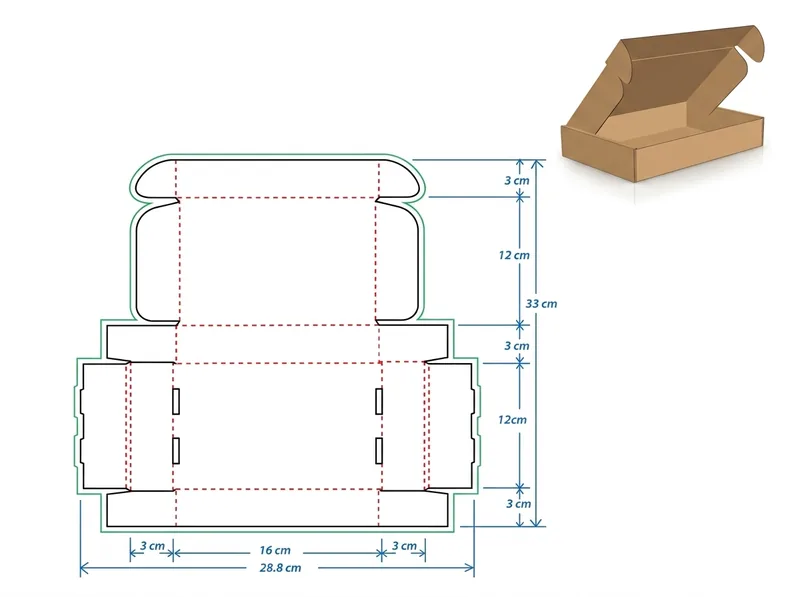
A dieline is the flat, 2D technical drawing of a pack, showing exactly where it is cut, creased and glued. Every box, carton and display starts as one. If the dieline is wrong, the finished pack will not fit the product, the tooling will be wrong and the print will not line up.
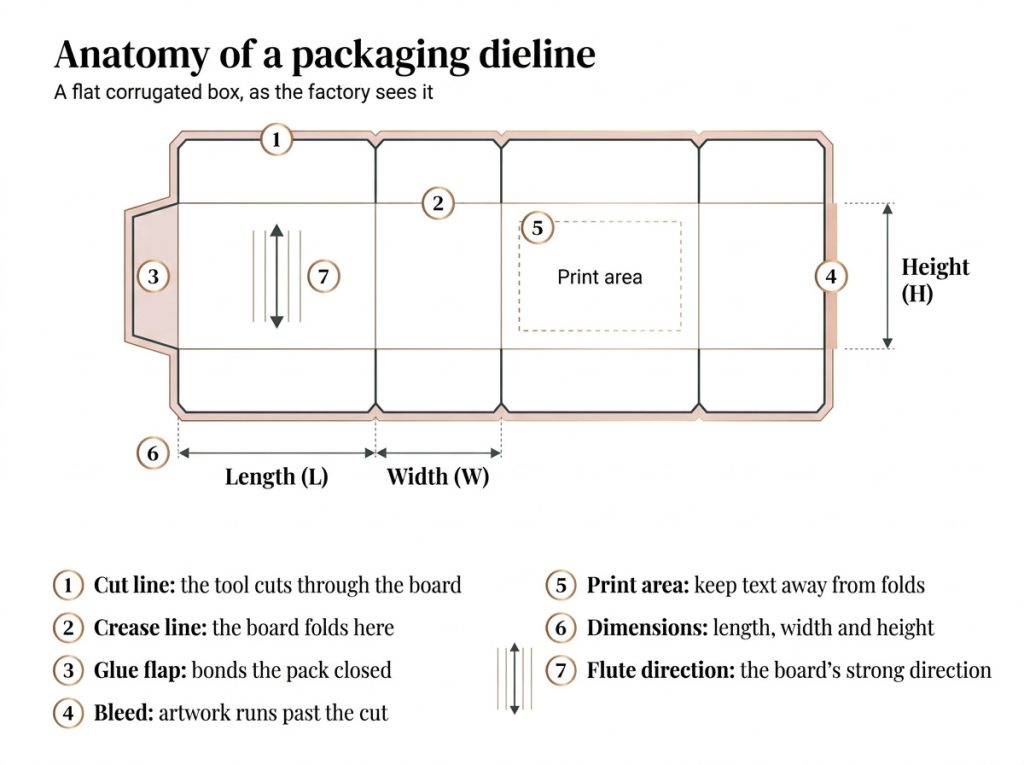
Most brands see packaging as a finished 3D object. The factory sees it as a flat sheet that has to be cut, folded and glued into that shape. The dieline is the bridge between the two, and it is the document that the die maker, the printer and the converter all work from.
What a dieline shows
The diagram above labels the main parts of a dieline on a simple corrugated box. A good dieline carries everything the factory needs to make the pack, and shows:
- Cut lines. Solid lines where the tool cuts through the board, including windows, hang holes and locking slots.
- Crease and fold lines. Usually dashed lines where the board is scored so it folds cleanly.
- Perforations. Where a tear-off panel or opening strip is needed.
- Glue flaps and tabs. The areas that bond the pack together, and the faces they attach to.
- Dimensions. Length, width and height, stated clearly as inside or outside measurements, plus the flat sheet size.
- Board details. The board type, flute or caliper, and the grain or flute direction.
- Print and bleed areas. Where artwork can run, how far it extends past the cut line, and where it must stay clear.
Dielines for corrugated packs often follow the FEFCO catalogue of standard styles, such as FEFCO 0201 for the regular slotted container and FEFCO 0427 for the die-cut mailer. A custom structure starts from a style like these, then changes it to suit the product.
A real example: a multi-part pack
Some packs are far more than one box. One of our recent projects was a pack for an EV charger, made of an outer box and three inner trays (top, middle and bottom) that sit inside it. That means four dielines that all have to work together.
The middle tray has cut-outs shaped for the product’s parts, and the outer box has a die-cut slot in its rounded flap. Every one of these shapes, and every fold, has to be right before the cutting die is made.
See more packs on our work page.
Dieline, artwork and 3D mockup: how they differ
These three are often mixed up, but each does a different job.
- The dieline is the structure. It defines the shape, the folds and the fit. It is a technical file made by a structural designer.
- The artwork is the graphics. It is placed on top of the dieline so that every logo, barcode and colour block lands on the right panel.
- The 3D mockup is a picture of the finished pack. It helps with approvals and presentations, but it cannot be sent to a factory.
The order matters. Structure comes first, artwork second. If the artwork is finished before the dieline is approved, any change to the structure means redoing the artwork.
Why a good dieline saves money
A dieline is cheap to fix on screen and expensive to fix on the production floor. A well-made one helps in four ways:
- Fewer sample rounds. The pack fits the product the first time, so you spend less time and money on revisions.
- Less board wasted. Layouts that nest well on the sheet use less material per pack.
- No tooling surprises. The cutting die is made once. A mistake found after the die is made means a new die.
- Better protection. For shipping packs, the right structure and board reduce damage in transit, which is often the largest hidden cost.
Common dieline mistakes
These are the problems we see most often:
- Using a generic template. A free template does not know your product, your board or your filling line.
- Ignoring board thickness. Board has thickness, so folds need allowances. Without them, panels bulge or do not close.
- Missing the flute direction. Corrugated board is stronger one way than the other. A pack drawn the wrong way round can crush or crease badly.
- Measuring the product with no clearance. A product that fits exactly on paper is hard to pack by hand or machine.
- Artwork over creases and cuts. Text or barcodes that cross a fold are distorted, and artwork with no bleed shows white edges.
- Skipping the physical sample. A dieline can look right on screen and still fail when folded. A white sample catches this before printing.
What to share with your designer
A short brief gets you a right-first-time dieline. Send as much of this as you have:
- The product’s size and weight, or the product itself if you can send it
- How it will be sold or shipped: retail shelf, e-commerce parcel, pallet display or export
- Any retailer or courier rules the pack must meet
- Preferred board, print method and approximate order quantity
- Any existing pack you like, or one that has failed
Ask for the final dieline as a vector file, such as AI, PDF or DXF, so your printer and converter can use it directly.
Frequently asked questions
What is the difference between a dieline and a template?
A template is a ready-made outline for a standard box size. A dieline is made for your product’s exact size, weight and board, so the pack fits it properly.
Who makes the dieline?
A structural packaging designer makes it. The graphic designer then places the artwork on top of the finished dieline.
What file format should I ask for?
Ask for a vector file such as AI, PDF or DXF, with the cut lines and crease lines on separate layers. Your printer and converter can then use it directly.
Do I need a physical sample before printing?
Yes. A plain white sample shows whether the pack fits and folds correctly, before you spend money on printing and tooling. We make these through our prototyping and printed samples service.
Can I reuse the dieline of an old pack for a new product?
Only if the new product has the same size and weight. If it does not, the structure needs to be checked and usually changed.
How long does a dieline take?
It depends on the pack. A simple box is quick, while multi-part packs and displays take longer. Send us your brief for an estimate.
Need a dieline for your pack?
Cut Fold Pack is a packaging structural design studio in Gurgaon, India. We design dielines for corrugated boxes, PDQ and POS displays and shipping packs, and we make a physical sample so you can check the fit before you print. Send us your product details through the contact page, or read more about our structural design and dieline service.
Written by the Cut Fold Pack structural design team, Gurgaon, India. Last updated 12 October 2026.